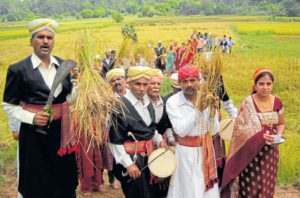
Puttari Poud, the actual day of the harvest festival, is celebrated on different days in different parts of Kodagu. It is celebrated on the day of Krithika nakshatra, which is a full moon day towards end of November or early December. This year it is celebrated on December 3rd. This day is also called Padi Poud or Deva Poud. Padi Poud is celebrated essentially by the villagers who come within the range of Padinaad one of the four nads Deva Poud means God’s Poud so called because the Poud is first celebrated in the temple of God Igguthappa in Padi, a small village near Kakkabbe, between Napoklu and Virajpet. It was also known as Aramane (palace) Poud because the Lingayat Rajas celebrated the festival on this day. The day after the Padi Poud, on the day of Rohini nakshatra all the other nads of Kodagu except Kiggattnaad, celebrate Nad Poud. In Kiggattnaad, the day of celebrating Puttari Poud is fixed by the nad people themselves. The ceremonies for celebrating the festival are the same all over Kodagu. Every house and shrine is painted (white-wash in the olden days) and the surroundings as well as the mandh where the kol dances are held are cleaned and spruced up. Doorways are decorated with festoons of marigold flowers and mango leaves. Every Kodava, wherever he may be, desires to go home to celebrate this festival. The cattle sent away for grazing are brought home and decked with bells. The festival is generally celebrated in the ain-mane of the okka. On the day of Puttari Poud, all the people of the village join in the festivities. The meda brings in Puttari Pachiya (basket) the Poleya a Puttari Palumbu (mat), the airi (a skilled artisan) a wooden ladle and a kutti (peg), the kolla (blacksmith) a sickle and the potter a Puttari kudike (pot). The Kaniya (astrologer) informs each house of the auspicious time for cutting the first ears of paddy, for preparing the nere (a bunch of different kind of leaves tied into rolls. A few ears of the new paddy crop are later inserted into the nere) and also for the feast. All these artisans are given rice, roasted rice flour, jaggery, salt, chillies, coconut oil, sesame, coconuts and Puttari Kalanji (a variety of yam eaten during the Puttari festival). The priest from the shrine or temple dedicated to the local village deity may be invited by some to sanctify their houses by sprinkling holy water. He is given rice, coconuts and jaggery or bananas.