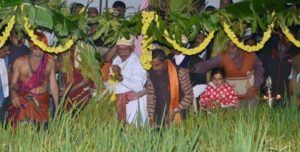
All those who wish to bring the kad dress in new clothes and stand in the kitchen before the taliyatakki bolcha. The head of the okka prays in front of the lamp and says:u Puttari comes once a year and today, as we carry the puttari kutti to the fields to receive the bountiful crop, the responsibility to see that nothing untoward happens lies with God Iguttappa and our Guru Karanava. Chanting “Poli, Poli, Deva” he takes the puttari kutti and hands it over to the man born under and auspicious nakshathra who was chosen by the astrologer to carry the kutti. This man is dressed in a white kupya. Then all the younger folk salute their elders, touching their feet in the traditional Kodava fashion. However, the man who carries the polud kutti should not salute anyone or be saluted by others (until he returns to the house with the kad). In some parts of Kodagu a person designated by the okkacarries the kutti. In the meanwhile, a muttaide hands the taliyatakka bolcha to an unmarried girl. Another person carries a basket of puffed rice and honey. Then the assembled men and women proceed to the field of their okkain the bright moonlight with drums, cymbals, and a gun. In some parts of Kodagu, they first assemble in the temple, in other parts in the ambala and in yet other parts members of each okka go straight to their paddy fields. Once the villagers assemble in the temple or the ambala they proceed to the fields set apart in the name of their deity or to their own paddy fields, for cutting the kad. The person who carries the polud kutti pours its contents milk, honey, etc. at the base of a cluster of paddy plants and all those assembled there shout “Poli, Poli, Deva”. Then the person carrying the kuttities one nere to the base of that cluster. At that moment a single shot is fired in the air. The person who carries the kutti then touches the paddy plants and raises his hands to his fore-head before he cuts the ears of paddy. He cuts five, seven, nine, or eleven clusters of paddy plants and places them in the kutti. It is then customary for all those assembled there to go to the shrine or ambala, carrying the newly cut ears of paddy, beating drums and cymbals, chanting “Poli, Poli, Deva”. There, some of the ears of paddy are thrust through the hollow of a nere and tied up in a prominent in the shrine or ambala. The puffed rice mixed with honey is distributed among all the assembled people at the shrine, ambala, or in the fields before they return to their homes. In some parts of Kodagu, after bringing in the new ears of paddy, shots are fired from about fifty feet away at a burning wick placed on a post or in a hollow of a tree near the house. On the way back to the house everyone stops at the kaimada where the lamp has been lit. Here they pray to the ancestors and tie a nere with some new ears of paddy in it to a pillar in the kaimada. When ascending the steps to the house, a muttaide or an unmarried girl washes the feet of the person who carries the pollud kutti and gives him some milk to drink. He drinks the milk and goes straight to the kitchen and keeps the pollud kutti there along with the kad. Youngsters tie the nere with the new ears of paddy to all the pillars in the house, and in prominent places in the rooms, to the pattaya (where grains are stored), chairs, cots, tables, boti, coconut trees, arecanut trees etc. Those who do not go to the paddy fields touch the kad and salute it in the ambala or in the house.