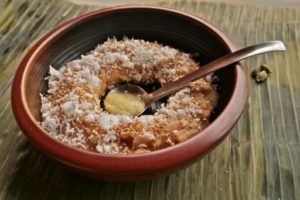
While the men prepare the nere in the courtyard, a muttaide (married woman) keeps all the items needed for the Kad Edupa ceremony in the kitchen. She fills a puttari pachiya with paddy. Over this she places a pani filled with paddy, over the pani a mana filled with rice, and on top of this a puttari mud pot full of rice flour. Close to it, she places a kutti containing some milk, honey, ghee, sesame seeds, ginger, and pieces of coconuts, scrapings of bitter gourd skin and tender shoots of the perambu cane. A sickle is also kept in the kutti. This kutti is called the puttari kutti or the polud kutti. A mukkali (tripod) is placed near it and a lit taliyatakki bolcha (brass plate with rice and lit lamp placed on it) with three betel leaves and three areca nuts on the plate is kept on it. That evening a meda goes first to the house of the takka, then to the other houses in the village, beating the kad pare on the drum. Before the meda comes to beat the kad pare in the house, a muttaide measures two manas of rice and soaks it in water. After the meda comes, she drains the water, pounds the rice and mixes a little of the rice powder with water to make a paste with which she marks dots on the sickle, the kutti, the pani, the mana and the puttari mud pot. A kavante or kavade fruit is dipped in the paste and used to mark the doors. Refreshments The members of the okka then eat boiled puttari kalanji mixed with honey or sugar and ghee.